
Optimised Inventory Operations with Racking Systems
At a tight-footprint logistics site near Changi, a lean 3PL crew implemented a major shift. They switched from block stacking to a racking layout overnight. The change reclaimed aisle space, enhanced forklift safety, and cut daily pallet-search time.
After several weeks, counting improved in speed, sidestepping costly footprint growth. This pragmatic approach benefits any operator seeking to maximise warehouse space using racking.
Racking converts vertical cubic capacity into organised, accessible storage. They facilitate steady material flow and accurate counts for https://www.ntlstorage.com/racking-system-components-and-their-functions. In Singapore’s high-cost land context, these systems are essential for efficient inventory storage solutions.
Core aims of racking are to optimise space, streamline movement, and lift overall supply-chain efficiency. Key benefits include better accessibility for forklifts and pallet jacks, reduced clutter and load-fall risks, flexibility for mixed SKUs, and the ability to scale as inventory changes.
Effective rollout blends assessment, design, sourcing, and proper installation. It also involves clear labelling and staff training. This ensures managing inventory with racking systems yields concrete gains in warehouse inventory management. It helps defer costly footprint expansion.
What is a warehouse racking system and why it matters for Singapore warehouses
Grasping how warehouse racking works is essential for logistics teams seeking to optimise space and flow. It’s a structural framework of racks and sometimes shelving used in warehouses, DCs, and industrial sites. It stores goods efficiently through vertical utilisation. Proper racking enhances picking, visibility, and safety.
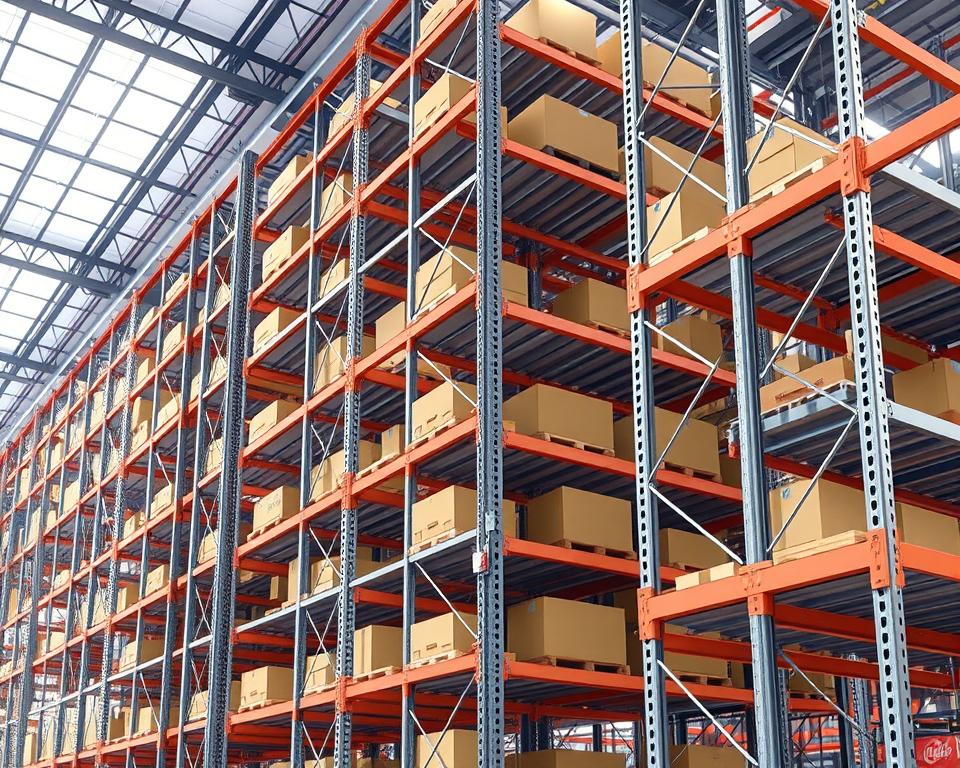
Definition and core components
A standard setup includes uprights, beams, wire decks, pallet supports, and more. They form bays and tiers that specify storage positions. Matching components to load characteristics is essential, with adjustments as inventory changes.
Role in modern warehousing and supply chains
Racking is vital to efficient inventory management by assigning dedicated locations per SKU. That accelerates counts and increases pick accuracy. Many operations integrate racking with barcode or RFID tracking and warehouse management systems for real-time visibility. The combination lifts throughput and supports diverse picking modes, improving fulfilment.
Relevance to Singapore’s constrained-space environment
With tight Singapore floor space, vertical capacity is paramount. High-density options (drive-in, pallet flow) cut aisle count and raise storage density. The right mix balances density with selectivity, ensuring efficient use of space without compromising safety.
Types of Racking Solutions & How to Select the Right Configuration
Selecting the correct racking is crucial for efficient warehouse operations. We outline how rack form influences daily operations. You’ll see common types compared, guidance to match to inventory, and Singapore-specific cost notes.
Overview of common rack types
Selective pallet racking is the most common choice. It provides direct aisle access to every pallet position. It’s ideal for fast-moving SKUs and adaptable layouts. Costs range from $75 to $300 per pallet position.
Drive-in and drive-thru racking offer high-density storage by letting forklifts enter rack lanes. Best for bulk or low-variability SKUs, they cut aisle needs. Budget $200–$500 per pallet spot.
Cantilever racks use arms for long/irregular items (e.g., timber, pipes). Front-column-free design eases loading. Expect about $150–$450 per arm for long-load storage.
Pushback racking stores multiple pallets per depth on carts or rails. It increases density https://www.ntlstorage.com/multi-level-racking-system-design-considerations-guide yet keeps recent pallets accessible. Budget around $200–$600 per slot.
Pallet flow or gravity racking uses rollers for FIFO operations. It suits perishable goods and expiry-managed stock. Costs commonly fall between $150 and $400 per pallet position.
Automated Storage and Retrieval Systems (AS/RS) and robotics vary widely in price. They deliver top density, fast throughput, and deep WMS integration. Costs hinge on target throughput, automation depth, and site constraints.
Matching rack type to inventory profile
Evaluate SKU dimensions, weight, turnover, and handling equipment when choosing a rack. High-velocity SKUs and mixed lines perform well with selective or AS/RS solutions. This supports efficient inventory storage solutions and fast picking cycles.
Use cantilever for long/odd loads. That keeps aisles clear and cuts handling time. Matching rack type to inventory avoids damage and speeds loading.
For FIFO-focused items, pallet-flow enforces expiry order automatically. They become essential to inventory management for regulated stock.
Bulk loads with few SKUs fit drive-in/drive-thru or pushback. Such systems maximise space and support dense inventory management with racking.
Cost Considerations by Rack Type
Costs involve more than list price. Rack hardware is just the starting line. Factor labour, anchors, decks, supports, and safety gear. Engineering fees, inspections, and staff training must also be included.
Reference ranges: selective $75–$300, drive-in $200–$500, cantilever $150–$450/arm, pushback $200–$600, pallet flow $150–$400, AS/RS variable. Review cost factors per https://www.ntlstorage.com/managing-inventory-with-racking-systems-complete-guide plus lifecycle impacts.
Factor in floor reinforcement, delivery, and possible downtime during installation. Long-term benefits of racking systems in inventory management include improved space utilisation, faster picking, and lower handling damage. Such gains frequently justify upfront costs.
| Rack Type | Best Use | Typical Unit Cost | Key Benefit |
|---|---|---|---|
| Selective pallet racking | Fast movers, mixed SKUs | $75–$300 per pallet position | Direct access to each pallet for fast picks |
| Drive-In / Drive-Thru | Bulk storage, low SKU variety | $200–$500 per pallet position | Density gains by cutting aisles |
| Cantilever | Long or irregular loads | $150–$450 per arm | Front-column-free for easy long-load handling |
| Push-Back | Higher density with easy access | $200–$600 / position | Multi-deep storage with simple retrieval |
| Pallet-Flow (Gravity) | FIFO for perishables/expiry | $150–$400 / position | Automatic FIFO for expiry control |
| AS/RS & robotics | High throughput, automated picking | Varies by throughput/automation | Top density, speed, and WMS integration |
managing inventory with racking systems
Fixed, logical storage locations on racks simplify inventory tracking. Assign each SKU a specific slot based on its master data. This reduces misplacement and speeds retrieval, enhancing warehouse inventory management.
Group SKUs by turns, dimensions, and compatibility. Designate specific zones for fast-moving items using an A/B/C layout. Place them at optimal pick-face heights to cut travel and raise pick rates.
Match stock rotation to product life cycle. Employ pallet flow or strict putaway rules for perishable goods to enforce FIFO. For dense LIFO use, consider pushback or drive-in.
Incorporate rack location into daily inventory control using racking. Conduct cycle counting at the rack level and perform physical slot audits to resolve discrepancies. Sync results to the WMS to maintain accuracy.
Streamline pick paths and staging to lower travel and errors. Set rack heights to forklift reach and ergonomic limits for safety. Train staff on load limits, pallet placement, beam clips, and spacing.
Monitor operational KPIs that reflect racking performance: order pick rate, putaway time, space utilisation, inventory accuracy, and rack damage incidents. Analyze trends weekly to identify areas for improvement.
Establish clear procedures, provide regular training, and implement simple visual controls to ensure adherence to floor rules. With shared understanding, racking control stays routine, reliable, and trackable.
Design, load calculations, and installation best practices
Creating a solid racking design in Singapore begins with a thorough site review. Gather data on inventory profiles, equipment specs, ceiling heights, column grids, and floor load limits. This front-end work is critical to optimising space with racking systems. It underpins safety and operational efficiency.
Assessment & Layout Planning
Begin by mapping SKU velocity with ABC analysis. Place fast-moving items in accessible zones near dispatch. Reserve deeper lanes for slower-moving bulk items. Balance aisle width for safe forklift operation with storage density.
Plan circulation for fire egress, sprinkler reach, and inspection access. Engage structural engineers and reputable vendors early. That keeps solutions compatible with the facility and compliant.
Load capacity and shelving load calculation
Calculate loads from material, dimensions, and support spacing. Rely on manufacturer tables with safety margins. Confirm deflection thresholds and per-pallet load limits.
For heavy or point loads, verify floor slab capacity. Engage engineers if reinforcement is required. Post clear load postings on each bay and train staff on per-level and per-bay limits. Routine checks avert overstress damage.
Proper shelving load calculation keeps operations compliant and reduces the risk of collapse.
Procurement and installation checklist
Use a racking procurement checklist to confirm rack type, bay dimensions, finish, and required accessories. Include compliance certs and warranty terms in documentation.
| Phase | Key Items | Stakeholders |
|---|---|---|
| Planning | Inventory profile; aisle width; fire egress; SKU zones | Warehouse manager, logistics planner, structural engineer |
| Engineer | Load tables; deflection checks; slab capacity | Manufacturer engineer, structural engineer |
| Procurement | Type; bay height; finish; accessories; compliance docs | Purchasing; vendor rep; safety officer |
| Installation | Site prep, anchor uprights, secure beams, add decking, wall ties | Certified installers, site supervisor |
| Verification | Plumb uprights, beam clips, clearance checks, signage | Inspector; safety officer; engineer |
| Post-Install | Initial engineering inspection, register with authorities, as-built drawings | Engineer; compliance; maintenance |
Follow best practices: clean/level floors, mark bays, anchor uprights, and install beams per spec. Fit decking and pallet supports, apply cross-ties and wall ties where required. Confirm clips/plumb and post clear load signs.
After installation, provide training on managing inventory with racking systems, safe loading, and damage reporting. Keep records of as-built drawings and inspections to support maintenance and future upgrades.
Inventory control using racking: organisation, labelling, and technology integration
A well-organised racking system and consistent labelling reduce errors and streamline daily operations. Begin with a logical system that assigns unique identifiers to each area. Make the format intuitive for pickers and consistent with your WMS.
Utilise durable labels, barcodes, and RFID tags at eye level on each bay and beam. Include SKU, maximum load capacity, and handling instructions on each label. Standardised label content improves control and reduces onboarding time.
Scanning (barcode/RFID) accelerates counts and real-time updates. Scanning at putaway and during picking ensures stock levels are accurate. This links control to WMS processes, reducing audit discrepancies.
Picking strategies influence rack arrangement. Zone picking assigns teams to zones. Batching groups SKUs for multiple orders. Waves schedule orders by departure windows. Use put-to-light or pick-to-light systems for fast-moving items to enhance efficiency.
Optimise pick paths to reduce travel and place high-velocity items near packing stations. Create dedicated pick faces and staging lanes for top SKUs. For perishable goods, use FIFO racks like pallet flow to enforce rotation and reduce waste.
Monitor pick accuracy, productivity, and travel time. Use data to rebalance SKU locations and rack allocations regularly. Small, frequent adjustments drive workflow optimisation.
For WMS integration, track bay/level/position in software. Set up location hierarchies, pick modes, replenishment rules, and paths. Align WMS picks to physical layout for seamless flow.
Racking plus automation can materially increase throughput at scale. Evaluate AS/RS, shuttles, and AMRs for dense, rapid operations. Integrate automation with barcode/RFID and WMS for accurate real-time control.
Safety, Maintenance & Regulatory Compliance for Racking
Safety starts with clear load ratings and physical safeguards. Label every bay with its capacity. Use clips/backstops/supports to restrict movement. Maintain clear aisles and marked egress routes.
Routine maintenance reduces downtime and risk. Do weekly visual checks for damage, displacement, and anchor issues. Schedule professional inspections by qualified engineers and document findings in an inspection log. This supports audits and insurance reviews.
When damage occurs, immediately take affected bays out of service until repairs are done. Secure anchors, restore safety clips, and renew labels quickly. A formal reporting process for rack impacts speeds repairs and prevents repeat incidents, preserving inventory management benefits.
In Singapore, follow workplace safety and building code requirements. Use international standards like OSHA where applicable. Train teams on safe stacking, capacity limits, and incident reporting. This fosters a safety culture that extends rack life and supports long-term maintenance and compliance.
FAQ
What is a warehouse racking system and why does it matter for Singapore warehouses?
A warehouse racking system is a structural framework that maximises storage space. It includes uprights, beams, and wire decks. It’s essential in Singapore’s high-cost, space-limited context. It allows for efficient use of space, delaying the need for expansion and reducing costs.
What are the core components of a racking system?
Core parts are uprights, load beams, and wire decking. They combine to form a structured rack system. They define bays and aisles, ensuring safe and efficient storage.
How do racking systems improve warehouse inventory management?
Fixed rack locations improve inventory control. That boosts accuracy and lowers loss. They also speed order fulfilment and support real-time tracking.
Which rack types are common and when should I choose them?
Common options include selective and drive-in/drive-thru. Selective suits high selectivity; drive-in suits bulk. Selection hinges on SKU profile and MHE.
How should I match rack type to my inventory profile?
Match by size, weight, and velocity. Use selective racking for high-turnover items. For bulk, consider drive-in or pushback. Verify lift-truck and aisle compatibility.
What are typical cost ranges per pallet position for different rack types?
Pricing depends on design and complexity. Selective pallet racks cost between $75 and $300 per position. Drive-in systems range from $200 to $500. Automation varies widely by throughput/integration.
What planning is needed before installation?
Start by assessing inventory and facility limits. Factor velocity and aisle requirements. Engage structural engineers and racking vendors to ensure compliance and proper installation.
How are load capacities and shelving calculations determined?
Load capacities depend on shelf material and dimensions. Manufacturers provide load tables to guide calculations. Display limits and confirm slab capacity for heavy/point loads.
What belongs in a procurement/installation checklist?
Confirm rack type, dimensions, and load capacities. Include required accessories and compliance documentation. Install per spec and schedule inspections.
How do I organise/label racking and integrate tech?
Implement a standardised numbering scheme for racking. Use durable labels and integrate with WMS for real-time inventory updates. This supports accurate slotting and automated picking.
Which picking strategies work best with racking?
Pair zone picking with selective racking for speed. FIFO stock fits pallet-flow. High-throughput SKUs benefit from automated systems. Design paths to minimise travel.
How do I balance storage density versus selectivity?
Balance is driven by velocity and access requirements. Use selective racking for high-turnover items and dense solutions for bulk storage. Site fast in selective, slow in dense.
Which safety/maintenance practices are essential?
Display limits and fit safety hardware. Do regular inspections and timely repairs. Keep aisles and egress clear. Document all inspections and repairs for audits and insurance.
Which compliance issues matter in Singapore?
Comply with local workplace safety standards and building codes. Work with qualified engineers and registered vendors. Apply recognised best practices and keep records for review.
How does racking support inventory control and stock rotation?
Fixed racking locations improve accuracy. Enforce rotation with FIFO lanes or rules. Organised zones and clear labels help manage expiry.
Which KPIs should I monitor post-implementation?
Measure picks/hour, putaway time, and utilisation. Monitor inventory accuracy and pick accuracy. Use metrics to rebalance locations and gauge ROI.
When should I consider automating with AS/RS or robotics?
Consider automation when throughput, labour, or space pressures are high. AS/RS and shuttle systems offer high density and speed. Evaluate lifecycle costs and integration needs first.
What are best practices for staff training related to racking systems?
Educate teams on limits, placement, and incident reporting. Run post-install training plus refreshers. Encourage a safety culture where operators report impacts promptly.
What should be included in recordkeeping and documentation?
Maintain as-built drawings, load calculations, and manufacturer load tables. Keep inspection/maintenance logs, compliance certs, and training records. These documents support audits, insurance claims, and lifecycle planning.